DevStudio AI 博客

开发 日志

关于 AI 智能体、RAG、SaaS MVP 与软件外包的实用文章 —— 由亲手交付它们的工程师撰写。

成本与规划

How Much Does AI Agent Development Cost in 2026?

AI agent development cost in 2026 typically ranges from $15,000–$40,000 for a simple workflow agent , $40,000–$120,000 for a production multi step agent with integrations , and $120,000–$400,000+ for an enterprise multi agent system with advanced orchestration, compliance, SSO, monitoring, and service level expectations.

阅读文章 →
成本与规划

How Much Does RAG Knowledge Base Development Cost?

RAG knowledge base development cost in 2026 typically ranges from $15,000–$40,000 for a basic single source RAG system , $40,000–$120,000 for a production multi source knowledge assistant , and $120,000–$300,000+ for an enterprise RAG platform with access control, real time sync, evaluation, monitoring, and compliance requirements.

阅读文章 →
成本与规划

SaaS MVP Development: Process, Cost, and Timeline

A focused SaaS MVP usually costs $15,000–$80,000 and takes 8–16 weeks when it includes authentication, one core workflow, a dashboard, basic admin, billing or payment setup, deployment, and QA.

阅读文章 →
成本与规划

Why Does Software Outsourcing Pricing Vary So Much?

Software outsourcing pricing varies because different vendors include different things in their quotes. One team may quote only coding hours. Another may include discovery, architecture, design, QA, project management, documentation, deployment, and post launch support. The same project brief can produce quotes with wide variation — in many markets, differences of 5× to 10× between the lowest and highest proposals are common.

阅读文章 →
成本与规划

How to Choose an AI Outsourcing Team: 5 CTO-Level Checks

A reliable AI outsourcing team should be able to explain the project scope, data requirements, system architecture, evaluation plan, security model, delivery process, ownership terms, and post launch support before you sign. If a vendor only shows a polished demo but cannot explain data handling, integration risks, model evaluation, failure cases, and handoff, they are not ready to build production AI systems.

阅读文章 →
外包指南

Software Outsourcing Contract Checklist: What Must Be Included?

A software outsourcing contract must include at minimum: scope definition, milestone and acceptance criteria, payment terms, intellectual property assignment, source code ownership, data confidentiality, account and infrastructure ownership, change order process, communication cadence, post launch support terms, termination conditions, and dispute resolution. Missing any of these creates risk that surfaces during or after the project — usually when it is most expensive to fix.

阅读文章 →
外包指南

How to Accept an AI Outsourcing Project: Criteria, Deliverables, and Handoff

Accepting an AI outsourcing project means verifying that the system works reliably under real conditions — not just that the demo looks good. Acceptance should test task completion rate, retrieval accuracy (for RAG), tool call success, error handling, security controls, latency, and human escalation flow. The vendor should deliver source code, documentation, deployment access, evaluation results, and a maintenance plan.

阅读文章 →
外包指南

Source Code Ownership in Outsourced Software Projects

In a properly structured outsourcing agreement, the client owns all custom source code created for the project upon delivery and payment. This must be stated explicitly in the contract through an IP assignment clause. Without it, the vendor may retain ownership or co ownership by default under many jurisdictions' copyright laws — even if the client paid for the work.

阅读文章 →
外包指南

Low-Code vs No-Code vs Custom Development: Which Should You Choose?

Choose no code when you need a simple internal tool or landing page fast and have no developer on the team. Choose low code when you need moderate customization, integrations, and some technical control without building from scratch. Choose custom development when your workflow is complex, your product is your competitive advantage, or you need full control over architecture, data, integrations, and scale.

阅读文章 →
外包指南

AI Agent Use Cases for SMBs: Where Automation Actually Pays Off

AI agents deliver the most value for SMBs in four areas: customer support triage, lead qualification and routing, internal knowledge retrieval, and repetitive operations workflows. These use cases work because they involve repeated tasks with clear inputs, defined outputs, and measurable time savings — not because AI is universally better than humans at everything.

阅读文章 →
AI 工程

How Multi-Agent Systems Work: Architecture, Orchestration, and When You Need One

A multi agent system uses multiple specialized AI agents that collaborate to complete tasks no single agent can handle well alone. Each agent has a defined role, tools, and scope. An orchestration layer coordinates their work — routing tasks, managing state, handling failures, and combining outputs.

阅读文章 →
AI 工程

RAG vs Fine-tuning vs Prompt Engineering: When to Use Each for Business AI

Use prompt engineering when you need the model to follow specific instructions, formats, or personas without custom data. Use RAG when the model must answer from your proprietary, changing documents. Use fine tuning when you need to change the model's behavior, output style, or classification patterns at scale. Most business AI systems start with prompt engineering, add RAG when proprietary knowledge is needed, and only fine tune when the other two are insufficient.

阅读文章 →
AI 工程

How to Evaluate AI Agent Reliability: Metrics, Tools, and Testing Strategies

AI agent evaluation requires measuring three layers: task completion (did it do the right thing?), output quality (how good was the result?), and operational reliability (does it work consistently in production?). No single metric captures agent performance — you need a scorecard combining accuracy, latency, cost, failure rate, and user satisfaction.

阅读文章 →
AI 工程

Building AI Workflows with LangGraph: When and Why to Use It

LangGraph is a framework for building stateful, multi step AI agent workflows as directed graphs. Use it when your AI agent needs conditional branching, loops, human in loop checkpoints, or persistent state across steps — situations where a simple chain of LLM calls is not enough.

阅读文章 →
AI 工程

AI Agents for Legal Operations: Document Review, Contract Analysis, and Compliance

AI agents for legal operations automate repetitive, high volume tasks that traditionally consume 60–80% of legal team time: document review, contract analysis, clause extraction, compliance monitoring, and due diligence. A production ready legal AI agent typically costs $50K–$150K to build and deploys in 10–16 weeks, delivering 40–70% time savings on targeted workflows.

阅读文章 →
AI 工程

AI Agents for HR and Recruitment: Screening, Scheduling, and Onboarding Automation

AI agents for HR and recruitment automate the high volume, repetitive tasks that consume 50–70% of HR team time: resume screening, interview scheduling, candidate communication, onboarding workflows, and employee FAQ handling. A production HR AI agent typically costs $30K–$100K to build and deploys in 8–14 weeks, reducing time to hire by 30–50% and freeing HR professionals for strategic work.

阅读文章 →
AI 工程

AI-Powered Customer Support for SaaS Companies: Build vs Buy in 2026

Buy an AI support platform (Intercom Fin, Zendesk AI, HubSpot Customer Agent) when your support needs are generic, your help center is well structured, and you want fast deployment with minimal engineering. Build a custom AI support agent when you need deep product integration, proprietary knowledge retrieval, custom workflows, multi system actions, or accuracy levels that off the shelf tools cannot reach.

阅读文章 →
AI 工程

In-House vs Outsourced AI Development: Cost, Speed, and Risk Comparison

Choose in house when AI is your core product, you can afford 3–6 months of hiring, and you need continuous iteration under full control. Choose outsourced when you need to launch faster than you can hire, lack specific AI expertise internally, or want a defined scope with predictable cost and timeline.

阅读文章 →
AI 工程

Cursor vs GitHub Copilot vs Windsurf for Development Teams: Which Improves Delivery Speed?

Cursor is best for teams that want deep AI integration in a VS Code like editor with strong multi file editing, codebase aware context, and agentic workflows. GitHub Copilot is best for teams already in the GitHub ecosystem that want seamless integration with pull requests, code review, and CI/CD without switching editors. Windsurf (by Codeium) is best for teams that want an AI native IDE with strong autonomous agent capabilities and competitive pricing.

阅读文章 →
项目就绪

Questions to Ask Before Starting an AI Project

The best way to avoid AI project surprises is to ask the right 50 questions across seven areas before development starts: business case, users and workflow, data and knowledge, integrations and systems, security and compliance, vendor and contract, and post launch operations. Most failed AI projects could be predicted from the questions that were skipped during scoping.

阅读文章 →
项目就绪

Production-Grade AI Agents vs Demo Agents: The Engineering Discipline That Ships

A demo agent is engineered to pass a curated path on a stage. A production grade AI agent is engineered to survive bad inputs, model drift, traffic spikes, and a quarterly cost review. The gap is not a smarter prompt. It is seven engineering disciplines: an Eval framework from Week 1, observability, token routing, failure handling, data privacy, security review, and a maintenance window. Skip them and your demo will not ship.

阅读文章 →
项目就绪

AI Agent Eval Framework: Why You Need It in Week 1, Not Week 8

An AI agent eval framework is the set of automated tests, golden datasets, and CI gates that decide whether a prompt or model change is allowed to ship. You need it in Week 1, not Week 8, because every week without evals you are silently locking in regressions you cannot detect. DevStudio ships eval scaffolding, ~200 test cases, and a CI deploy block before the first agent reply is ever shown to a real user.

阅读文章 →
项目就绪

AI Agent Token Cost Audit: How to Cut Runtime Costs by 50-70%

An AI agent token cost audit inspects four layers — workflow, user, model, and environment — to find where tokens are wasted, then applies five levers: model routing, caching, context compression, prompt distillation, and streaming with early stopping. Across DevStudio internal projects from 2024 to 2026, this combination has reduced runtime LLM costs by a representative 50 70% on already shipped agents, without measurable quality loss on the agent's evaluation suite. It is not a guaranteed number; it is the range we keep seeing on B2B agents that were built fast and never tuned.

阅读文章 →
项目就绪

Why 60% of Enterprise AI Pilots Die: Failure Modes and How to Avoid Them

Most enterprise AI pilots die for four reasons: the wrong workflow was chosen, no evaluation framework was built, the underlying data was not ready, or token and runtime cost spiraled past revenue. Whether you cite the MIT NANDA figure (95% no measurable P&L) or the BCG figure (74% struggle to derive value), the pattern is the same. Pilots that survive have an Eval framework in week one, a clean data slice, and a unit cost ceiling defined before code is written.

阅读文章 →
项目就绪

Outsourcing vs In-House AI Development in 2026: A Decision Framework with Real Numbers

For a first AI agent or RAG project, outsourcing to a senior engineering vendor is faster and cheaper through month 18 in most situations: a $40k–$120k vendor engagement ships in 8–14 weeks, while building an in house AI team to ship the same capability takes 6–9 months and $400k–$900k in fully loaded cost before the first production traffic moves. In house wins when AI is core competence, hiring is solvable, and the workflow is your ten year moat. Vendor wins when timeline is tight, the team is not yet hired, or the work is bursty.

阅读文章 →
项目就绪

Software Outsourcing RFP Template (2026): The 12 Sections That Actually Filter Out Bad Vendors

A useful software outsourcing RFP for a $40k $200k engagement is 12 sections long, gets responses in 7 10 working days, and is structured to filter out vendors who cannot answer specific engineering discipline questions. The wrong RFP — generic, deadline light, no acceptance criteria — gets you 30 sales deck responses indistinguishable from each other. The right RFP gets you 3 5 responses where the vendors who cannot answer have already self selected out.

阅读文章 →
项目就绪

Nearshoring vs Offshoring vs Onshore for AI Development: A Cost, Speed, and Quality Decision Matrix

Onshore AI engineering teams in the US run $180 $320 blended hourly. Nearshore (Latin America from US, Eastern Europe from UK/EU) runs $80 $150. Offshore (East Asia, South Asia) runs $40 $95. The three models have different sweet spots: onshore wins for short, sensitive, regulated work; nearshore wins for fully loaded sprint cadence with same day overlap; offshore wins for production grade engineering at startup friendly project rates when the vendor brings senior practitioners and Eval Week 1 discipline. A serious senior offshore vendor delivers 3 4x the cost ratio of onshore at parity quality on AI specific work in 2026.

阅读文章 →
项目就绪

Outsourcing Team Onboarding Checklist: The 30-Item Framework That Saves Week 4

The single biggest predictor of whether an outsourcing engagement ships on time is whether onboarding is done in week 1 or whether it slowly leaks across weeks 1 4. A complete 30 item onboarding checklist — covering access provisioning, code base orientation, decision making contracts, eval expectations, and escalation paths — turns week 4 from "still waiting on access to staging" into "first production change shipped, eval pass rate measured." This is the cheapest week of an engagement to optimize, and the highest leverage.

阅读文章 →
项目就绪

Enterprise RAG Knowledge Base Architecture in 2026: Patterns, Anti-Patterns, and the 8 Components You Cannot Skip

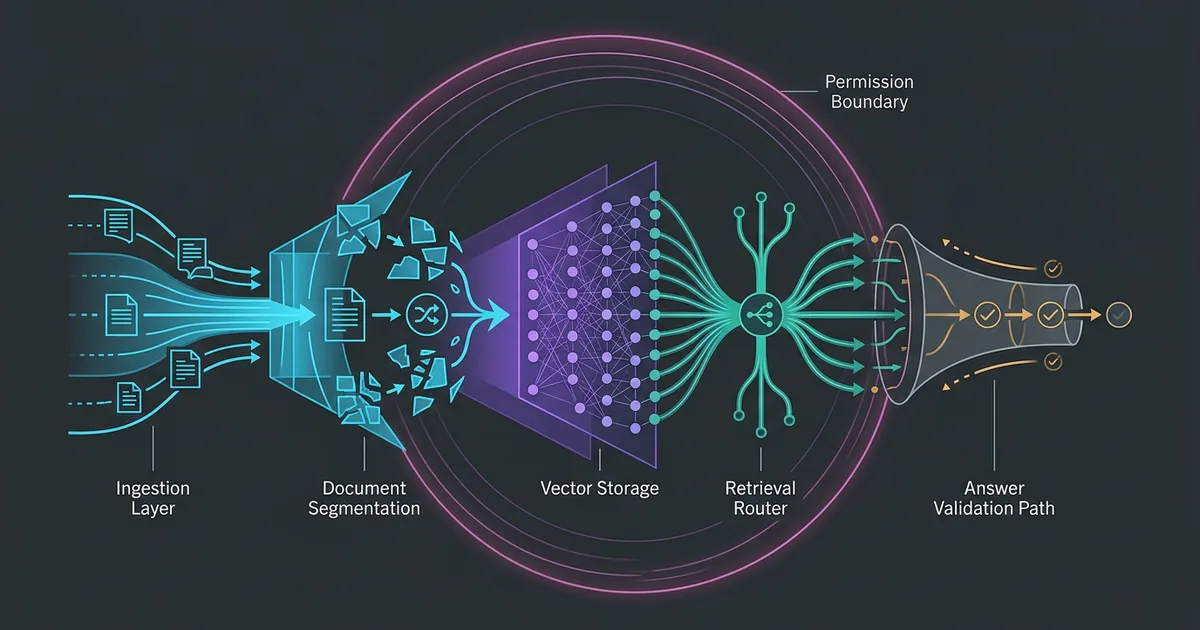
A production grade enterprise RAG architecture in 2026 has 8 named components: ingestion + chunking, embedding + indexing, retrieval (hybrid BM25 + vector), reranking, grounded generation, evaluation, observability, and access control. Skipping any one of these — most commonly evaluation or access control — is the difference between a RAG demo that ships in week 4 and a production RAG system that survives twelve months in front of real users. The components matter; the order and the boundaries between them matter more.

阅读文章 →
项目就绪

RAG Evaluation and Monitoring Guide: How to Measure Retrieval Quality, Generation Quality, and Production Drift

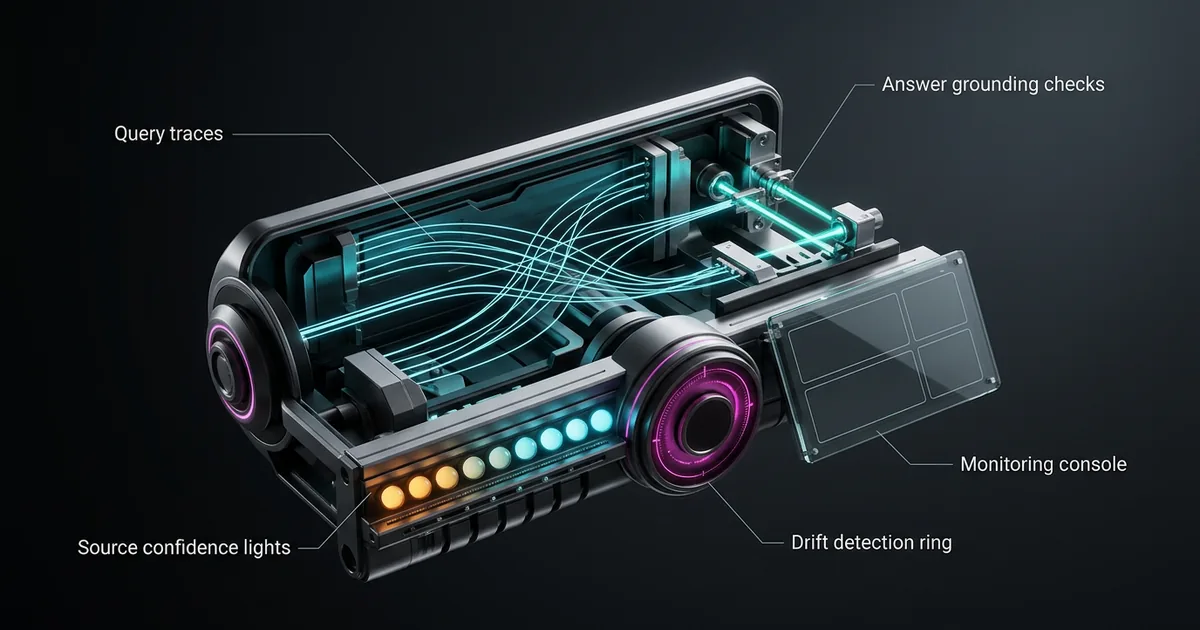
A production grade RAG evaluation framework measures three orthogonal qualities — retrieval (does the right context come back), generation (is the answer correct given that context), and grounding (did the answer actually use that context) — across a labeled set of 200+ reference questions. Each quality has its own metric set and threshold. Production drift is a separate fourth concern measured continuously against a held out sample of live traffic. Most RAG pilots fail because they conflate these four into "the answer looks fine" instead of measuring each component independently.

阅读文章 →
项目就绪

RAG vs Vector Search vs LLM Fine-Tuning: When to Use Each (and What Most Teams Get Wrong)

Vector search is one component (semantic similarity retrieval). RAG is a complete pipeline that uses retrieval (vector + lexical) to ground LLM generation. Fine tuning teaches an LLM stable patterns (style, format, narrow domain knowledge) that do not change frequently. The three are not interchangeable choices; they answer different questions. The 2026 production default for "use my company knowledge in answers" is RAG with hybrid retrieval. Fine tuning shows up as a complement (for tone or narrow stable patterns), not as a replacement.

阅读文章 →
项目就绪

SaaS MVP Tech Stack 2026: The Pre-Verified Modules That Save 6 Weeks of Build Time

A 2026 SaaS MVP tech stack should be 80% pre verified modules and 20% your unique value proposition. The 80% — auth, billing, email, storage, payments, observability, deployment — is the cheapest and least differentiated work. Picking battle tested modules (Auth0/Clerk, Stripe, Resend/Postmark, S3, Sentry/Datadog, Cloudflare/Vercel/AWS) and customizing them to brand saves the 6 weeks most teams spend on plumbing. The 20% is your moat: domain logic, workflow, AI surface, and pricing model. Spend engineering effort there, not on rewriting authentication.

阅读文章 →