Launch Your SaaS MVP Fast

Don't over-engineer. We build functional, beautiful MVPs with the core features necessary to win your first customers and secure funding.

  • Rapid Prototyping & Design
  • Core Feature Prioritization
  • Scalable Backend Foundation
  • Multi-tenant Architecture

Engagements typically start from $5,000 USD. Final scope priced after discovery call.

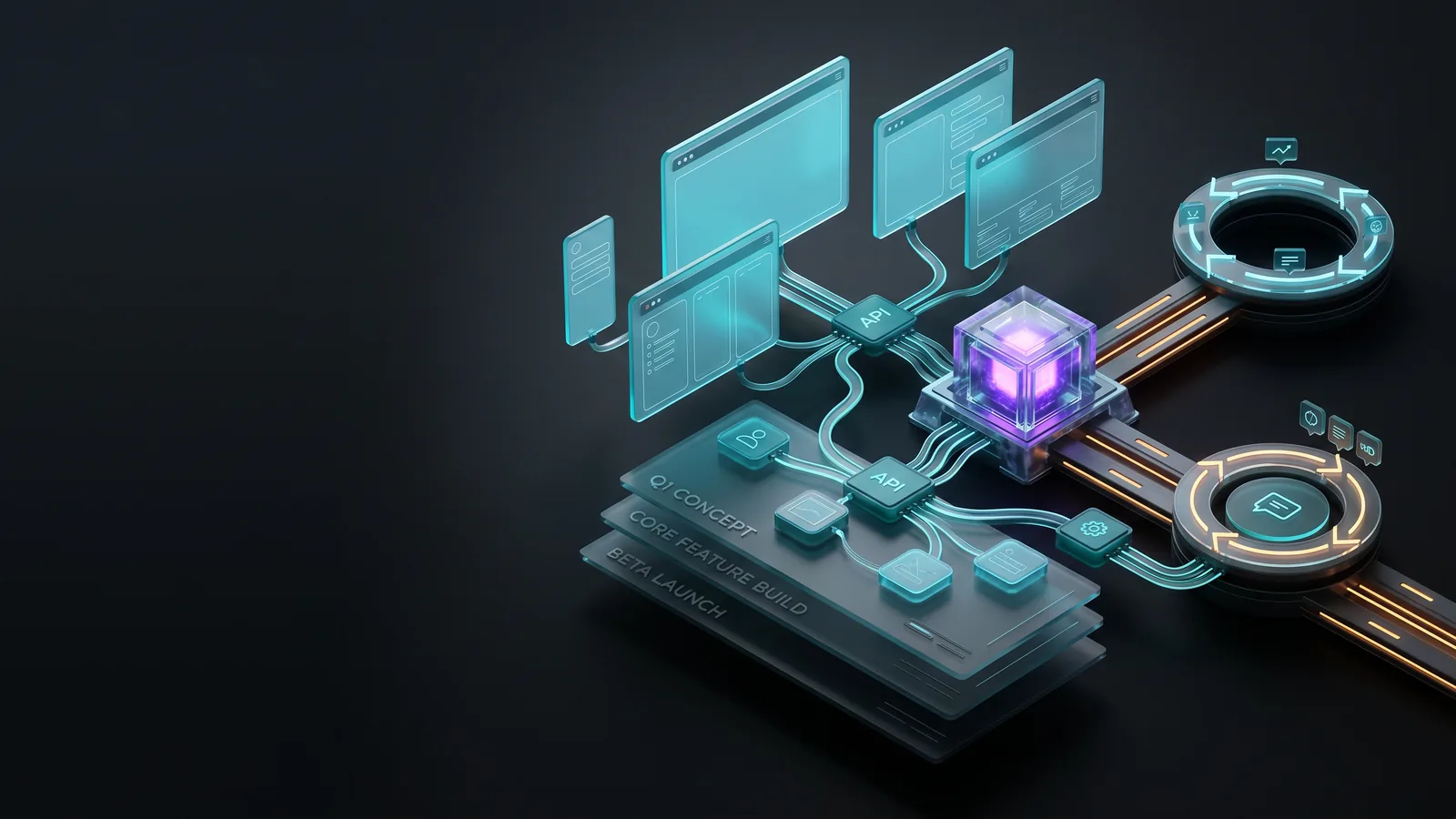
SaaS MVP planning workspace with prototype panels and roadmap cards

How DevStudio ships SaaS MVP

Hangzhou-based, ex-Alibaba senior engineering team. Project rate $14k–$85k over 4–10 weeks. Three engineering commitments written into every contract before any code is shipped.

Commitment 1

Eval Week 1

200+ reference cases with expected outputs and a CI-gated scoring rubric land in the first sprint — before any production code merges. Accuracy is measured from day one.

Commitment 2

6-Month QA Window

Six-month warranty on production fixes. Customer owns source code, deployment docs, and runbook from day one of handover — no vendor lock-in.

Commitment 3

Quarterly Token Audit

Token routing, caching, and model selection re-evaluated every 90 days against the eval set so unit economics stay predictable as traffic grows.

Entry Product — Paid Scoping

$700–$2,800, 1–2 weeks — written go/no-go before any build engagement

A fixed-price feasibility engagement. About one in four scopings recommends not building. Fee credits 100% toward a build engagement if you proceed.

Book a Scoping

Agile MVP Strategy

Our MVP development cycle is optimized for speed without sacrificing technical debt control. By using pre-verified modules for authentication, billing, and data management, we focus 100% of our energy on your unique value proposition. This approach allows startups to enter the market with a production-ready application within 6-8 weeks, significantly reducing time-to-market and R&D costs. Last updated: 2026-05-19.

Project inquiry form. Fields marked with an asterisk are required.

Where this service fits

A SaaS MVP is not a smaller version of the final product. It is a sharp, end-to-end vertical slice through the riskiest assumption in the business plan, built fast enough that the answer arrives before the runway runs out. The patterns below are the ones where a 6-to-10-week MVP engagement actually moves the needle.

First-time founders pre-funding

Demo-ready MVP for a fundraising round

Investors fund traction or insight. If you do not yet have traction, the MVP is the artifact that proves the insight: a working product they can click through, with one or two real users on it, and a clear story about what the next 12 months unlocks. We build to that bar — not a polished product, not a Figma deck, but a demo that survives a 30-minute partner meeting.

Funded founders in solution-validation

Wedge feature MVP for a defined target customer

After seed, the question changes: do real users in the target ICP get value from one specific workflow, repeatedly? We build a wedge MVP — one workflow, one user role, one integration if any — and instrument it so usage tells the truth. This is the fastest path to the data that decides whether to scale, pivot, or kill.

Operators with a side bet

Side-bet MVP under an operating company

Successful operators often launch a second business that solves a problem the first business surfaced. We build that side-bet MVP without disturbing the parent business: separate codebase, separate billing, separate brand if needed, and a clean architectural fence so a future spin-off or acquisition is technically simple.

Bootstrappers

Profitable-from-month-one MVP for a niche audience

Bootstrappers do not have the luxury of building for a hypothetical large market and figuring out monetization later. We build the MVP with billing wired from the first day, the pricing page real, and the conversion path measurable from week one — because the success metric for a bootstrapped MVP is paid users, not signups.

Corporates running internal venture studios

Internal venture MVP that bypasses corporate IT timelines

Corporate venture studios fight a structural problem: corporate IT timelines do not match startup speeds. We build the MVP outside the corporate stack on purpose — modern infra, clean security posture, no shared dependencies — so the venture can move at startup speed and integrate with the parent later if it earns the right to integrate.

Existing SaaS adding a second product

Companion-product MVP for an existing customer base

Established SaaS companies often want a second product targeted at their existing customer base. We build the companion MVP with shared identity and billing where it helps, isolated everything else where it does not, and a clear architectural seam so the second product can survive on its own merits rather than being a feature that pretends to be a product.

How we deliver

A SaaS MVP engagement is six to ten weeks. The phases are tight on purpose; an MVP that takes 16 weeks is not an MVP, it is a small product. We protect the timeline by saying no to scope creep early and often, and by reusing battle-tested platform pieces (auth, billing, email, storage) rather than building them from scratch.

  1. Risk identification and scope cut

    Week 1

    We name the single riskiest assumption in the business plan that the MVP must validate, then cut scope ruthlessly to that assumption. Everything that does not move the needle on the riskiest assumption is dropped to v2. This is uncomfortable but it is the difference between an MVP that ships in eight weeks and one that drags into month four.

  2. Pre-built platform setup and design system kickoff

    Week 1 — 2

    We stand up the platform layer using pre-verified modules: Auth0 / Clerk for identity, Stripe for billing, Postmark / Resend for email, S3-compatible storage. The design system is set up from a starter kit and customized to the brand rather than designed from a blank canvas. Time we spend here pays back through the rest of the engagement.

  3. Vertical-slice build of the riskiest workflow

    Week 2 — 6

    We build the riskiest workflow end-to-end first, instrumented from day one. The user can go from sign-up to the moment of value in one continuous path. We resist the temptation to build sideways breadth before the vertical slice is real.

  4. Hardening and pricing surface

    Week 6 — 8

    Performance profile, basic security review, billing wired up, pricing page real, terms and privacy pages live. The MVP is now something a paying user can actually buy, not just a demo someone can click through.

  5. Launch with measurement

    Week 8 — 10

    Phased launch: friends and family first, then a curated waitlist, then public. Every step is measured (activation, time-to-first-value, conversion to paid, churn signals) so the next decision is data-driven rather than vibes-driven.

Milestones you can hold us to

On a typical 8-week SaaS MVP engagement, here is what you actually receive at each milestone.

Milestone
Week 1

Riskiest-assumption canvas signed off

A one-page canvas naming the single assumption the MVP must validate, the success metric, the kill metric, and the explicit list of features dropped to v2. Posted somewhere visible so scope creep meets it head-on.

Milestone
Week 2

Platform layer live and design system styled

Auth, billing, email, and storage running in staging. Design system customized to brand. Marketing landing page deployed at the production domain so the launch is not blocked on DNS or copy.

Milestone
Week 5

Vertical slice clickable end-to-end in staging

A real user can sign up, complete the riskiest workflow, and trigger the moment of value, with usage instrumented for every step. This is the earliest point where the MVP can be demoed to investors or pilot users.

Milestone
Week 7

Billing wired and pricing page real

Stripe integrated, plans configured, pricing page deployed, terms and privacy live. A real customer can buy from this point onward.

Milestone
Week 8

Phased launch begins

Friends-and-family launch with measurement dashboards live. Activation funnel, conversion to paid, and churn signals tracked from day one.

Milestone
Week 10

Post-launch review and v2 plan

Two weeks of real usage data analyzed against the riskiest-assumption canvas. Decision: scale, pivot, or kill. v2 scope written up against what the data showed, not against what we hoped to find.

Frequently asked questions

The most common questions from founders evaluating us against an alternative agency, a no-code build, or a fractional CTO.

What does a SaaS MVP project typically cost?
A focused 8-to-10-week MVP engagement lands between $25,000 and $80,000 USD depending on the riskiest-assumption complexity and the integration surface. Engagements typically start from $5,000 USD for a one-week risk-and-scope phase that you keep regardless of whether you continue. We are explicit about cost up front because an underfunded MVP is worse than no MVP.
How is this different from a no-code MVP on Bubble or Webflow?
No-code is the right answer when the riskiest assumption is about audience or messaging, not about product. If you can validate the assumption with a landing page, a Calendly link, and a Notion-based fulfillment process, do that first. We come in when the assumption is about workflow, integration, or technical feasibility — places where no-code creates a ceiling that becomes painful exactly when validation succeeds.
Will the MVP scale, or do we have to rebuild it later?
The MVP is built on production-grade infrastructure (TypeScript, Next.js, Postgres, modern cloud) so the bones do not need to be replaced. Some specific MVP shortcuts — admin tools that are spreadsheets, manual onboarding flows, single-tenant data model — are designed to be replaced once the assumption is validated. The architecture decision record names exactly which choices are throwaway and which are load-bearing.
Who owns the code and the IP?
You do, fully. Code lands in your GitHub organization from the first commit, infrastructure in your cloud accounts. We sign work-for-hire and mutual NDA at engagement start. There are no vendor-lock-in layers between you and the product, and you can take it elsewhere at any milestone.
What if our cofounder situation is messy or undecided?
We will not start a build engagement until the IP and ownership structure on your side is clean — single founder, signed cofounder agreement, or a corporate parent with a written internal venture mandate. This is for your protection more than ours. The fastest way to lose an MVP is to ship it into a structure that cannot defend the IP later.
Do you take equity or only cash?
Cash only. Equity contracts mix poorly with services contracts, and we have seen too many founders regret diluting early for build work. We will take partial cash with a milestone-based payment schedule for funded founders, but the engagement is priced and paid in cash, not equity.
Can you keep building features after launch?
Yes — we offer a post-launch retainer at a defined cadence (typically two-week increments at a fixed monthly cost) for buyers who want to keep moving without rebuilding the relationship. We can also do a build-train-handover where we hire and train your in-house engineering team during the build so they own the product from day one of production.
How do you handle the design side?
Every MVP includes a customized design system based on a starter kit. For buyers who want a fully bespoke brand, we partner with vetted design studios and integrate their work into the product, but the engagement is then priced separately because brand design at depth is not the same craft as MVP engineering.