AI-Powered Visual Commerce

Stop waiting for photo shoots. Our AI visual pipelines generate studio-quality product images, lifestyle shots, and marketing banners in seconds.

  • Stable Diffusion & Flux Orchestration
  • Automated Lifestyle Scene Generation
  • Brand-consistent Style Tuning
  • High-speed Image Processing Pipelines

Engagements typically start from $5,000 USD. Final scope priced after discovery call.

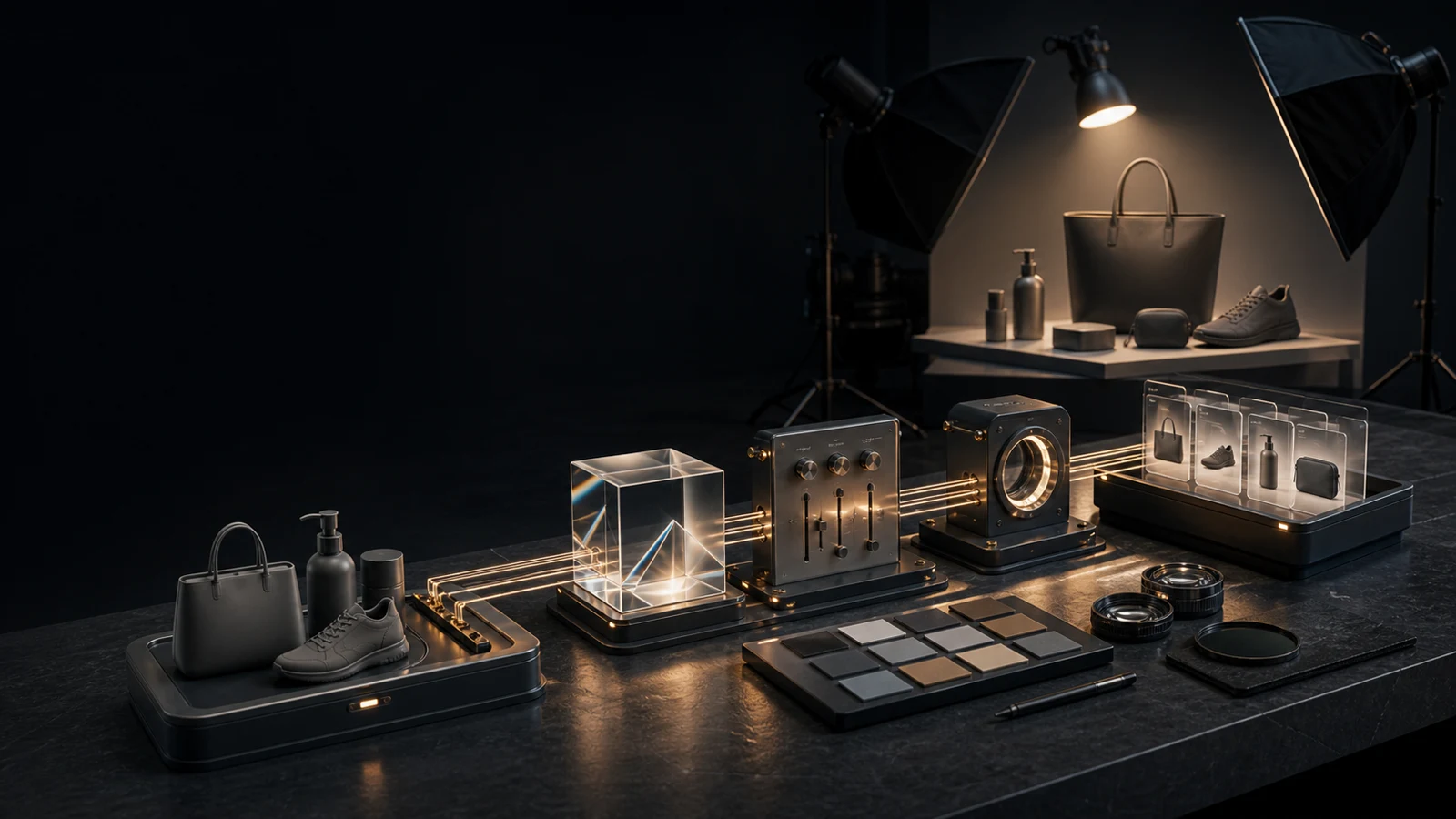
E-commerce AI visual generation pipeline with product image asset grids

How DevStudio ships visual pipeline

Hangzhou-based, ex-Alibaba senior engineering team. Project rate $14k–$85k over 4–10 weeks. Three engineering commitments written into every contract before any code is shipped.

Commitment 1

Eval Week 1

200+ reference cases with expected outputs and a CI-gated scoring rubric land in the first sprint — before any production code merges. Accuracy is measured from day one.

Commitment 2

6-Month QA Window

Six-month warranty on production fixes. Customer owns source code, deployment docs, and runbook from day one of handover — no vendor lock-in.

Commitment 3

Quarterly Token Audit

Token routing, caching, and model selection re-evaluated every 90 days against the eval set so unit economics stay predictable as traffic grows.

Entry Product — Paid Scoping

$700–$2,800, 1–2 weeks — written go/no-go before any build engagement

A fixed-price feasibility engagement. About one in four scopings recommends not building. Fee credits 100% toward a build engagement if you proceed.

Book a Scoping

Visual Intelligence at Scale

We leverage advanced LoRA training and ComfyUI-based pipelines to ensure 100% brand consistency. Our E-commerce visual solutions integrate directly into your Shopify or custom storefronts, allowing for real-time personalization and A/B testing of visual assets. This drastically reduces creative production costs while increasing engagement and conversion rates through dynamic, high-fidelity imagery. Last updated: 2026-05-19.

Project inquiry form. Fields marked with an asterisk are required.

Where this service fits

AI visual generation is now production-ready for a specific class of e-commerce work: the long tail of catalog imagery, lifestyle scenes, and seasonal refreshes where shoot cost is high and turnaround is slow. Hero-shot photography for flagship products is still better done with cameras and a stylist; everything else is increasingly an AI pipeline problem. The patterns below are the ones where our buyers see clean ROI.

DTC brands with broad SKU counts

Long-tail catalog photography for hundreds to thousands of SKUs

Photographing a 1,500-SKU catalog with traditional studio production is a quarter of in-house work or a five-figure invoice from an outside studio per shoot day. We build an AI pipeline that takes a single product photo (or 3D render) and generates the full catalog set: white background, lifestyle scenes in 4-6 settings, scale references, in-context shots, seasonal variants. Human review stays in the loop on the front of the queue; the bulk moves at catalog speed.

Marketplace sellers

Channel-specific image variants that meet each marketplace spec

Amazon, Walmart, TikTok Shop, eBay, Mercado Libre, and regional marketplaces each have different image specs (aspect ratio, background rules, infographic limits). We build a pipeline that outputs the channel-specific set from one source asset: every variant compliant with the channel rules, named per the channel naming convention, and queued for upload through the channel API.

Apparel and home goods

Lifestyle scene generation across model diversity and environments

Apparel and home goods sell on lifestyle context, and traditional production caps the diversity of models and environments at the budget line. AI generation reverses the economics: we build a pipeline that swaps model demographics, body types, and environments while preserving the product, so the storefront can show the product in 12 lifestyle contexts rather than two. Brand consistency is enforced via LoRA training on a brand-approved style palette.

Seasonal campaigns and rapid refresh

Seasonal and campaign refresh at the speed of merchandising

Black Friday, Mother's Day, Lunar New Year, summer collection, fall collection — each campaign demands a refreshed visual surface and a traditional production cycle does not move that fast. We build pipelines that re-skin the catalog visuals per campaign in 48 to 72 hours: same products, new context, new color palette, new copy overlays where requested.

Marketing and ad operations

Ad creative variant generation at scale

Paid acquisition rewards creative volume: more variants, faster iteration, faster fatigue replacement. We build pipelines that produce ad-creative variants tuned per channel (Meta, TikTok, Google, Reddit), per audience segment, and per campaign theme, with the variants instrumented so the buyer can see which variant won and rebuild the next batch from the winning pattern.

Custom-product configurators

Real-time visualization for personalized or configurable products

Configurable products (custom apparel, custom furniture, custom packaging) traditionally rely on photorealistic 3D rendering — expensive to set up and slow to update. We build AI-driven configurators that generate the visualization in seconds when the customer changes a configuration, integrated into the storefront so the customer sees their actual choice rather than a stock photo of the closest variant.
How we deliver

Visual generation engagements move through five phases. The phase order matters: brand-style training before pipeline build, pipeline build before scale-out, scale-out before the storefront integration. Skipping the brand-style phase produces images that look generic and brand teams reject; skipping pipeline observability produces images that drift over time without anyone noticing.

  1. Brand-style codification and reference set

    Week 1 — 2

    We sit with the brand team to codify the visual style — palette, lighting, composition rules, model demographics, environmental cues — and assemble a reference set of 80 to 200 brand-approved images. The reference set drives LoRA training in the next phase. This is where brand voice gets translated into something a model can learn.

  2. LoRA training and visual evaluation

    Week 2 — 4

    We train brand-style LoRAs on the reference set, evaluate on a held-out test set, and iterate until the brand team signs off on a representative output sample. Evaluation is done in a structured review session, not by ad-hoc emails — every approved sample goes into the gold set, every rejected sample becomes a training signal.

  3. Pipeline build with ComfyUI or custom orchestration

    Week 4 — 7

    We build the generation pipeline — typically ComfyUI for visual workflow orchestration, with custom code for queue management, channel-specific output formatting, and integration with your storefront systems. Every generated asset is tagged with the prompt, model, and reference set used so any drift can be traced back to its cause.

  4. Scale-out and quality control

    Week 7 — 9

    We run the pipeline against a representative slice of the real catalog and measure the human-review pass rate. We tune prompts, references, and post-processing until the pass rate clears the agreed production threshold. Quality control stays in the loop forever; the question is what fraction of output reaches a human reviewer, not whether it ever does.

  5. Storefront integration and operate-with-you

    Week 9 — 11 + ongoing

    Generated assets land in your DAM with the right metadata and are pushed to your storefront, marketplace channels, or ad platforms through the channel APIs. We stay attached for the first month of production to triage real edge cases, then transition to operate-with-you: monthly catalog refresh, quarterly model upgrade evaluation, and a defined queue for new product launches.

Milestones you can hold us to

On a typical 11-week visual pipeline engagement, here is what you actually receive at each milestone.

Milestone
Week 2

Brand-style reference set assembled

A documented brand-style spec and a reference set of 80 to 200 brand-approved images, signed off by the brand team. This is the asset the LoRA training will produce against.

Milestone
Week 4

Brand-style LoRA trained and signed off

A trained LoRA producing brand-consistent outputs on a held-out test set. Brand team signs off on a representative sample before pipeline construction begins.

Milestone
Week 7

Pipeline producing channel-specific output

The full pipeline running end-to-end, accepting product source assets and producing channel-specific output sets (white background, lifestyle, marketplace variants). Every output tagged with full provenance.

Milestone
Week 9

Quality control loop tuned

Human-review pass rate measured against a representative catalog slice. Pipeline tuned until pass rate clears the agreed production threshold. Reviewer queue UX is in place so the daily operation is sustainable.

Milestone
Week 10

Storefront and channel integration live

Generated assets flowing from the DAM to your storefront, marketplace channels, and ad platforms with the right metadata. Catalog refresh and seasonal-refresh workflows scheduled.

Milestone
Week 11

Operate-with-you handover

Operations runbook delivered, model-upgrade evaluation cadence agreed, monthly cost dashboard in place, on-call expectations documented. Your team owns day-to-day operation.

Frequently asked questions

The questions buyers ask before committing to an AI visual pipeline rather than a traditional production budget.

Will the output look generic or off-brand?
Not if the brand-style codification phase is done properly. The single biggest predictor of generic-looking AI imagery is buyers who skip the reference-set work and ask for "your default style". Our pipelines train on your reference set, are reviewed by your brand team before scale-out, and are re-tuned whenever the brand evolves. Generic output is a process problem, not a model-capability problem.
How is this different from MidJourney or DALL-E used directly?
Frontier consumer tools are great for ideation and one-off creative work; they fail at production scale because they have no provenance, no consistency over a catalog, no integration with your storefront, no quality-control loop, and no operating model for keeping the visuals current as your products and brand evolve. Our pipelines treat the model as one component in a larger system, not as the system itself.
What does a visual pipeline project typically cost?
A first production pipeline lands between $25,000 and $90,000 USD depending on catalog size, channel count, brand-style complexity, and storefront integration scope. Subsequent product lines on the same pipeline are roughly 30% to 50% of that cost because the brand-style training and orchestration layers are reused. Engagements typically start from $5,000 USD for a brand-style codification phase that you keep regardless of whether you continue.
Can the pipeline keep up when the catalog grows?
Yes — the pipeline is designed for catalog growth from day one. Generation throughput scales with GPU allocation, and we tune the pipeline so adding 1,000 SKUs is a configuration change rather than a project. The bottleneck for most buyers is not generation throughput; it is human review throughput, and we design the reviewer UX explicitly for high-volume work so the human side scales with the pipeline.
How do you handle products that need photorealistic accuracy (e.g. jewelry)?
Some product categories — fine jewelry, certain electronics, prescription eyewear — still need camera-based hero photography for the primary listing image. Our pipelines coexist with traditional production: cameras for the hero shot, AI for the long-tail variants, lifestyle scenes, and seasonal refresh. The split is decided per category in the discovery phase rather than imposed by us.
Who owns the trained LoRAs and the generated assets?
You do, fully. Trained LoRAs land in your model storage. Generated assets land in your DAM with full metadata. We sign work-for-hire and mutual NDA at engagement start. There is no vendor-lock-in layer between you and the assets; you can take everything elsewhere at any milestone.
How do we handle copyright and likeness concerns?
We work with your legal team to scope what the pipeline can and cannot generate. Real-person likeness is restricted by default; talent imagery uses contracted models with appropriate releases or licensed digital twins. Brand-IP overlap (using competitor products, trademarked context, real-world scenes that imply endorsement) is handled in the prompt-policy layer of the pipeline so unsafe outputs are caught before they leave the queue.
How do we know the pipeline is not silently degrading over time?
Every pipeline ships with a quality-control loop and observability. Daily samples are auto-scored against the held-out test set, drift alerts fire when scores move outside the tolerance band, and the monthly operate-with-you cycle includes a structured review of the held-out outputs. Silent degradation is the failure mode AI pipelines have if no one watches them; ours are watched.